There’s no single best collateral loan in the Philippines for everyone. The right option depends on the asset you can pledge, how much you need, how much you can afford to repay, and the lender’s terms.
A collateral loan may be worth considering when you have an eligible asset and financial need. Before applying, look for a loan that:
- accepts the asset you actually own,
- provides enough funds for your purpose,
- clearly discloses its interest, fees, and other charges,
- has repayment terms that fit your budget, and
- comes from a lender authorized to offer the type of credit it provides.
You can find collateral-backed financing from banks, SEC-authorized financing and lending companies, pawnshops, and some cooperatives.
What Makes a Collateral Loan the Right One for You?
A collateral loan, also called a secured loan, is backed by an asset you pledge to the lender. Depending on the product, the collateral may include a vehicle, real estate property, jewelry, or other accepted asset.
If you fail to repay the loan according to the agreement, the lender may have rights over the collateral, subject to the applicable signed agreement and laws.
Because the lender has security for the loan, some secured loans may offer higher borrowing amounts or different pricing from unsecured loans. These terms aren’t automatic, so compare the actual offer rather than assuming that collateral always means a cheaper loan.
| Factor | What to Ask the Lender | Why It Matters |
| Total cost | “What is the effective interest rate (EIR)?” | Helps you compare the overall cost of credit, including applicable charges |
| Loan amount | “How much can I borrow against my asset’s assessed value?” | Shows whether the loan can cover your actual need |
| Term | “What repayment periods are available?” | A longer term may reduce the periodic payment but increase the total amount paid |
| Fees | “What fees or deductions apply?” | Upfront deductions can reduce the cash you actually receive |
| Use of asset | “Can I continue using the asset while the loan is active?” | Collateral arrangements differ by lender and product |
| Default rules | “What happens if I miss a payment?” | Helps you understand the consequences before borrowing |
| Lender authorization | “Can I verify your authority to operate?” | Helps you check whether you’re dealing with a legitimate lender |
Common Types of Collateral in the Philippines
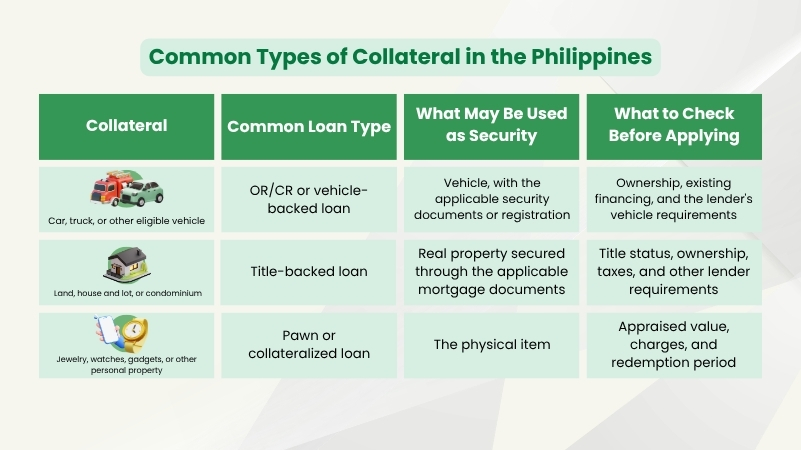
| Collateral | Common Loan Type | What May Be Used as Security | What to Check Before Applying |
| Car, truck, or other eligible vehicle | OR/CR or vehicle-backed loan | Vehicle, with the applicable security documents or registration | Ownership, existing financing, and the lender’s vehicle requirements |
| Land, house and lot, or condominium | Title-backed loan | Real property secured through the applicable mortgage documents | Title status, ownership, taxes, and other lender requirements |
| Jewelry, watches, gadgets, or other personal property | Pawn or collateralized loan | The physical item | Appraised value, charges, and redemption period |
The loan amount, repayment period, and application requirements vary by collateral type and lender. Property-backed loans may involve more documentation and verification, while pawn transactions are generally based on the value of the item being pledged.
For vehicle owners, see how Sangla OR/CR works. For property owners, read how Sangla Titulo works in the Philippines. If the property is inherited or co-owned, see whether you can sangla an inherited or co-owned land title.
How to Compare Collateral Loan Offers
Compare the Effective Interest Rate (EIR), not just the advertised rate
The Truth in Lending Act, or Republic Act No. 3765, requires creditors to provide specified credit information before the credit transaction is completed, including applicable finance charges and the amount to be financed.
The Bangko Sentral ng Pilipinas also explains that the effective interest rate reflects the true cost of a loan and that borrowers should obtain the details of the loan, including applicable fees and charges, from the financial institution.
For example, two lenders may advertise the same monthly interest rate but have different fees or deductions. If one lender deducts more charges from the approved amount, you may receive less cash even though the advertised rate looks similar.
Ask for the disclosure statement and compare the EIR, net proceeds, payment schedule, and applicable charges before deciding.
Also ask how the interest is calculated, such as whether the loan uses a diminishing balance or another method. Our guide to common loan terms in the Philippines explains the difference.
Check your net proceeds
The approved loan amount and the amount you actually receive may differ because of applicable fees, deductions, insurance, taxes, or other charges.
For example, if a loan is approved for ₱100,000 but ₱5,000 in applicable deductions are taken from the proceeds, you would receive ₱95,000. Check the disclosure statement for the exact figures applicable to your loan.
Match the repayment term to your cash flow
Don’t base the decision only on the lowest monthly payment.
A longer repayment period can make each payment more manageable, but it may also increase the total amount you pay over the life of the loan. Choose a payment that remains manageable even during a month when your income or business cash flow is lower.
Where to Find a Collateral Loan in the Philippines
| Where to Look | Regulator or Authority | Typical Collateral | May Suit You If… |
| Banks | BSP | Real property, vehicles, and other accepted collateral | You meet the lender’s income, credit, and documentation requirements |
| Financing companies | SEC | Vehicles, property, and other accepted collateral | You are looking for an asset-backed financing product |
| Pawnshops | BSP | Jewelry and other personal property accepted by the pawnshop | You need a smaller amount and can pledge an eligible personal item |
| Credit cooperatives | CDA, with additional rules depending on the cooperative’s structure | Varies | You’re a qualified member and the cooperative offers the type of credit you need |
The SEC states that lending companies need a Certificate of Authority to engage in lending activities. The SEC also maintains separate requirements for financing companies.
The BSP supervises pawnshops and provides a verifier that consumers can use to check whether a financial institution is registered with or supervised by the BSP. The verifier itself does not guarantee an institution’s safety or financial soundness.
Cooperatives are registered and regulated through the Cooperative Development Authority, although financial service cooperatives can also be subject to BSP regulation for their financial services.
How to verify a lender before you apply
- Check the appropriate authority. For SEC-regulated financing and lending companies, verify the company’s registration and Certificate of Authority. The SEC states that only registered lending and financing companies with the required Certificate of Authority may operate within its regulatory framework.
- Check the company name. Make sure the legal name on the authorization and loan documents matches the company you’re dealing with.
- Review the disclosure statement. Don’t rely only on an advertised interest rate. Check the amount financed, applicable charges, net proceeds, payment schedule, and effective interest rate.
- Be cautious with payment requests. Treat requests for payments to personal accounts or unexplained fees as red flags and verify them directly with the lender.
- Don’t rush the signing process. Read the loan agreement, disclosure statement, security documents, and default provisions before signing.
SAFC publishes its corporate and compliance information on its Certifications & Legal Compliance page.
Risks to Weigh Before Pledging an Asset

A collateral loan gives you access to financing, but the pledged asset creates an additional risk if you cannot meet your repayment obligations.
- You may lose the asset. Depending on the type of security and the terms of the agreement, default can result in repossession, foreclosure, sale, or another enforcement action.
- The asset may be encumbered. A vehicle or property used as collateral may have restrictions or documentation requirements while the loan remains outstanding.
- Borrowing more than you need can increase your repayment burden. A higher available loan amount doesn’t mean you need to borrow the maximum.
- Shared ownership can require additional documentation. If an asset is co-owned or inherited, confirm the lender’s requirements before applying.
Before signing, consider how you would continue making payments if your income or business cash flow dropped for several months.
Frequently Asked Questions
Is a collateral loan cheaper than a loan without collateral?
Not necessarily. A secured loan may have different pricing from an unsecured loan, but the actual cost depends on the lender, loan product, amount, term, fees, and other charges. Compare the EIR and total repayment amount rather than assuming that collateral means a lower cost.
If you don’t want to pledge an asset, see our guide to personal loan alternatives in the Philippines.
Can I use a car that’s still being financed?
It depends on the lender and the existing financing arrangement. A vehicle that is already subject to an existing loan or encumbrance may not qualify for another collateral loan unless the lender offers a specific arrangement.
If you’re still paying for your vehicle, a car loan takeout may be a separate option to explore.
Can I get a collateral loan with a low credit score?
Having a low credit score doesn’t automatically guarantee disapproval. Lenders may still evaluate your income, ability to repay, credit history, documents, and the value and condition of the collateral.
See our list of bad credit loan alternatives.
What documents do I usually need?
Requirements vary by lender and collateral type. They may include valid identification, proof of income, and documents showing ownership or authority over the collateral.
Ask the lender for its current requirements before preparing your application. You can also check the lender’s help center or contact a branch.
The Bottom Line
The right collateral loan depends on the asset you’re pledging, the amount you need, the repayment period, and the total cost of the loan.
Before you sign, verify the lender, request the disclosure statement, compare the EIR and net proceeds, and make sure you understand what happens if you miss payments.
If your collateral is a vehicle or property title, you can explore SAFC’s Sangla OR/CR loan and Sangla Titulo loan. Women entrepreneurs can also explore the JUANAsenso Loan, while public utility vehicle (PUV) and TNVS operators can look into the BiyaHERO Loan, each subject to the product’s current eligibility and requirements.
Visit your nearest SAFC branch or contact us to request a loan computation and disclosure statement before deciding.