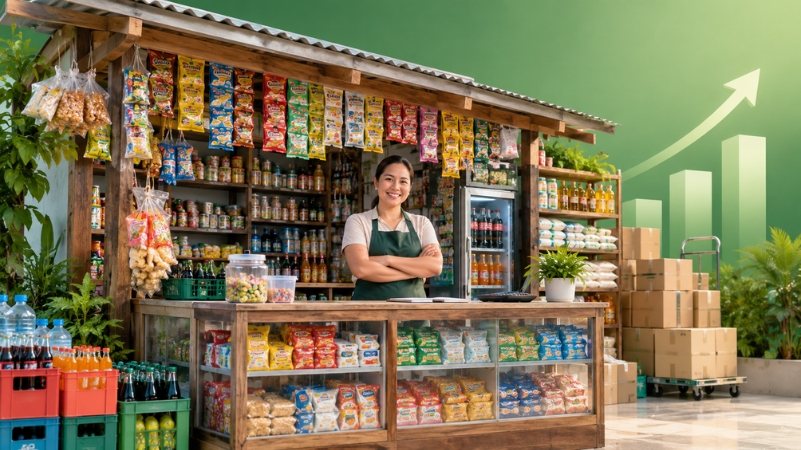
A sari-sari store loan can genuinely help your tindahan grow — but only when the money buys something that earns back more than it costs. Borrowing to stock fast-moving goods or add a freezer is very different from borrowing to plug losses. This guide walks you through the decisions that actually matter before you apply.
The good news: with roughly 1.3 million sari-sari stores across the country, lenders and fintechs increasingly offer financing built for small retailers. The catch is that terms, requirements, and who qualifies differ a lot from one lender to the next.
Do You Actually Need a Sari-Sari Store Loan?
Not every store needs a loan. Borrowing makes sense when the funds do one clear job: help you sell more or spend less per sale.
A loan is likely productive when it will:
- Restock inventory you consistently sell out of
- Let you buy in bulk at a lower unit price
- Fund equipment that earns (freezer, rice dispenser, load/e-payment setup)
A loan is risky when it’s used to:
- Cover ongoing losses month after month
- Pay personal or household expenses unrelated to the store
- Replenish the savings you depleted
What You Can (and Shouldn’t) Use the Funds For
Common, productive uses:
| Use | Why it can pay off |
| Inventory / fast-movers | More stock of what already sells = more sales |
| Bulk buying | Lower cost per unit, better profit margin |
| Equipment | Freezer, display, load & bills-payment services add income |
| Store improvement | Better shelving/lighting can lift foot traffic |
| Working capital | Smooths cash flow between deliveries |
Use with caution: repeatedly borrowing to cover shortfalls, or diverting store funds to personal spending. These quietly turn a livelihood into a debt trap.
How Much Should You Borrow?
Borrow to the need, not to the maximum offered.
A simple way to size it:
- List exactly what the money is for (e.g., ₱15,000 restock + ₱8,000 freezer).
- Add a small buffer only if your sales are seasonal.
- Stop there. Extra “just in case” cash you don’t deploy still charges interest.
Sari-sari stores often run on around a 10% markup, so every peso of repayment has to come out of a small slice of each sale.
Can Your Daily Takings Carry the Repayment?
This is the question most guides skip. Before applying, do a rough check:
- Estimate your average daily profit (not sales — profit after cost of goods).
- Compare it to the daily or weekly repayment the loan would require.
- If repayment eats most of your profit, the loan is too big or too short.
Practical rule of thumb: if you can’t comfortably make the payment on a slow sales week, the terms don’t fit your store yet — adjust the amount or the term.
Where Can You Get Financing?
Lenders fall into a few types, and the right one depends on your situation:
- Microfinance NGOs & digital lenders / BNPL (e.g., microfinance institutions, inventory-financing apps): smaller amounts, often no hard collateral, best for quick restocking.
- Financing companies: larger, more structured capital — often collateral-based.
Where SAFC fits (honest view): SAFC doesn’t offer a tiny unsecured “sari-sari store loan.” It’s a fit when you need meaningful growth capital and either:
- You’re a woman entrepreneur — SAFC’s JUANAsenso is a business loan program for women, or
- You have collateral — a land title (Sangla Titulo) or a vehicle you keep using while it backs the loan (Sangla OR/CR).
If you have neither collateral nor qualify for a women’s program, a microfinance or digital micro-lender is likely the more realistic first step.
Common Requirements (These Vary by Lender)
Requirements differ by lender, but many small-business lenders ask for some combination of:
- Two valid government ID/s
- Proof the store exists (photos, location, sometimes DTI/barangay registration)
- Basic proof of income or sales activity
- Collateral documents only for secured loans (e.g., land title, OR/CR)
Treat any single lender’s checklist as that lender’s — not universal. Always confirm with the lender before applying.
When Should You Be Careful About Borrowing?
Pause if:
- Your sales are shrinking, not just seasonal
- You already have loans you’re struggling to pay
- You’re borrowing to pay another loan
- The purpose is personal, not for the store
- You don’t understand the total cost (interest + fees) yet
Borrowing under pressure rarely ends well. A short delay to plan beats a fast loan you can’t carry.
Frequently Asked Questions
Magkano ang puhunan para sa sari-sari store?
It varies widely — many owners start or restock with anywhere from a few thousand pesos upward, depending on store size and product range. Borrow to your specific plan, not to a figure you saw online.
Pwede bang mag-loan kahit walang collateral?
Yes, with some lenders — microfinance and digital micro-lenders often lend without hard collateral, usually in smaller amounts. Collateral-based financing (like Sangla Titulo or Sangla OR/CR) is for larger amounts and requires assets.
Is borrowing to expand different from borrowing to cover losses?
Very. Expansion debt buys something that earns. Loss-covering debt just postpones a problem — fix the store’s finances first.
Final Checklist Before You Borrow
- Clear, single purpose for the funds
- Exact amount needed (with minimal buffer)
- Daily/weekly repayment fits a slow week
- You understand total cost (interest + fees)
- You chose a lender type that matches your situation
- The loan grows the store — it doesn’t just cover losses
Financing is a tool. Used well, it helps a small tindahan become a bigger one. Used carelessly, it adds pressure. Decide with your numbers, not with the hype.