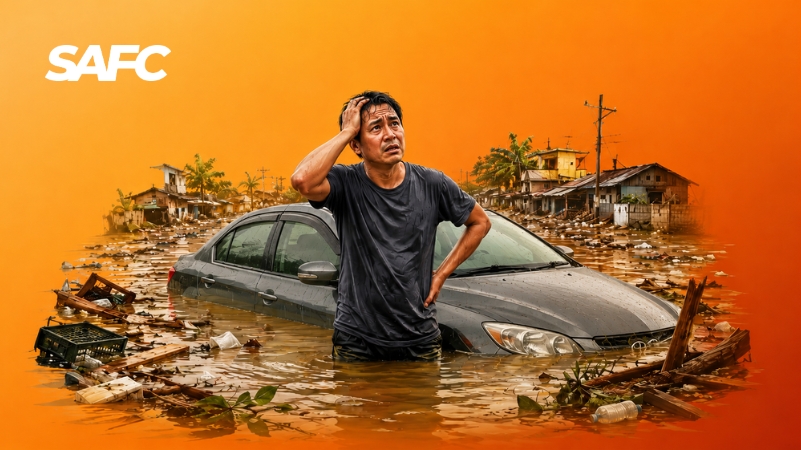
The short answer: Stay safe first, and do not try to start the engine — that’s the fastest way to turn a repairable car into a write-off. If it’s safe to do so, move the car out of standing water, disconnect the battery, take photos and videos, and call your insurer early. Then assess the damage carefully before deciding whether to repair or replace.
If you’re reading this with a soaked car parked outside — or still watching the water creep up — take a breath. It feels like a disaster, and the worry about what it’ll cost is completely understandable. But the outcome often depends more on what you do next—and how quickly you act—than on how deep the water got.
Here in the Philippines, flooding is rarely a surprise. Habagat season, sudden downpours, and typhoons can put water on the road faster than anyone can react, and low-lying areas across Metro Manila and the provinces flood again and again. It’s a situation thousands of Filipino motorists face every year, and there’s a clear, sensible way through it.
This guide covers what to do after your car gets flooded, from the first safety checks to the bigger decisions that come after. You’ll learn why starting the engine can make the damage worse, how flood insurance in the Philippines may help, and when it may be time to repair, replace, or explore other options.
The goal is simple: to help you make a calm, informed decision before panic leads to expensive mistakes.
What to Do Right Now: The First Steps After Your Car Floods
Work through these in order. The first few are about your safety — the car can wait.
1. Make sure you and your passengers are safe first.
A car is replaceable; you are not. If water is still rising or moving, don’t go near the vehicle. Moving floodwater only knee-deep can sweep you off your feet, and you can’t see what’s beneath the surface — open drainage, debris, or live electrical hazards. Get everyone to higher ground and deal with the car only once it’s genuinely safe to approach.
2. Don’t start the engine.
This is the single most important rule. It’s tempting to turn the key just to “see if it still works.” Don’t. If water has reached the engine’s air intake, trying to start or even crank the engine can pull water into the cylinders and cause hydrolock — and because water doesn’t compress, that can bend or break internal engine parts in an instant. A car that might have been repairable can become a total write-off in the time it takes to turn the key. When in doubt, leave it off and let a professional check it first.
What is hydrolock? It’s when water gets into the engine’s cylinders, where only air and fuel are supposed to be. Because liquid can’t be compressed, the engine seizes — often causing serious, expensive internal damage. It’s the main reason you never start a flooded car.
3. If it’s safe, move the car out of standing water.
The longer the vehicle sits in water, especially muddy or dirty floodwater — the more damage spreads through the interior, the electrical system, and the components. If the car can be pushed or towed to dry, higher ground without starting the engine, do that. Never wade into deep or moving water to reach it.
4. Document everything with photos and videos.
Before you clean or move anything, take clear photos and video of the car in the flood and the water level both inside and outside. Capture the surroundings too. This is the evidence your insurer will rely on to assess your claim, so the more thorough you are now, the smoother that process tends to be later.
5. Disconnect the battery carefully.
A modern car runs on sensitive electronics, and leaving power flowing through wet components invites short circuits and corrosion. Disconnecting the battery helps prevent that. But safety comes first: never attempt this while standing in water, and if you’re not confident doing it, wait for a professional rather than risk it.
📌 Note:
EVs and hybrids carry high-voltage systems that are dangerous to handle when wet. Do not attempt to disconnect anything yourself. Keep clear of the vehicle and call the manufacturer’s roadside assistance or a qualified technician.
6. Call your insurance provider early.
Report the flooding to your insurer as soon as you reasonably can. Filing early gets your claim moving before insurers are swamped after a major storm, and they can tell you exactly what they need and what your specific policy covers. (We’ll explain how flood coverage actually works in the Philippines in the next section, it’s not always what people assume.)
7. Let the interior air out gently.
Once it’s safe and the water has receded, open the doors to let the cabin breathe and start drying out. The water usually brings mud and debris with it, and trapped moisture turns into mold and foul odors within a day or two. Airing it out early helps, but hold off on major DIY teardown until the car has been properly assessed.
8. Have the car towed for a professional inspection.
Unless the water never rises above the floor, the safest next move is to have the vehicle towed to a service center or your dealership for inspection. A professional can check the engine, electrical systems, and fluids properly, and communicate the car’s true condition to your insurer, which protects both your safety and your claim.
Once these immediate steps are handled, you can move on to the decisions that actually determine the cost: what your insurance covers, and whether the car is worth repairing.
“Can’t I Just Try Starting It?” — Why the Answer Is Usually No
This is the question almost everyone asks, so let’s be direct about it.
If the floodwater stays low, never rising above the floor of the car, and the interior is only a little damp, your car may well be fine after proper drying and a check-up. That’s the best-case scenario.
But if water reached the dashboard, the seats, or higher, assume the engine and electrical systems were affected and do not attempt to start it. As covered earlier, cranking a flooded engine risks hydrolock and can cause severe, often irreversible damage. The cruel irony is that starting the car to “test” it is frequently the thing that destroys it. When you’re unsure how high the water got, treat it as too high until a professional confirms otherwise.
There’s a second, less obvious reason to be patient: a flooded car can seem fine and then fail weeks later. Even if it starts and drives at first, floodwater leaves moisture and grime inside the electrical connectors and modules. Over the following days, weeks, and months, that quietly corrodes the wiring — and electrical faults can start appearing long after the flood, sometimes one after another. So “it turned on, so it’s okay” is not a reliable all-clear. This is exactly why a proper inspection matters more than a quick test start.
Folk fixes that don’t work (and what to do instead)
When a car floods, well-meaning advice spreads fast. Here are the common ones worth ignoring:
- “Put it in rice.” Rice can’t dry out a car — there’s far too much water, in far too many hidden places, and rice does little even for a wet phone. It won’t draw moisture from behind your dashboard or under your carpets. If you want a drying aid for the interior, silica gel desiccant is far more effective and won’t attract pests the way rice can. The real work, though, is removing the water and using proper airflow and a dehumidifier.
- “Just spray WD40 on all the electrical connections.” Spraying water-displacer across your car’s electronics is not a reliable fix for flood damage and can do more harm than good. Wet electrical components and modules need to be properly assessed, cleaned, and dried by someone who knows what they’re doing — not blanket-sprayed and hoped for the best.
- “Wait a few weeks and it’ll start right up.” Standing moisture inside electrical parts causes corrosion the entire time it sits. Waiting doesn’t heal a flooded car — it lets the damage spread. The priority is getting the water out and the car inspected quickly, not leaving it parked in hope.
So what should you do instead of starting it?
Keep it simple and safe:
- Leave the engine off until it’s been inspected.
- Get the water out and the interior dry as soon as it’s safe (airflow, fans, a dehumidifier — not rice).
- Have a qualified mechanic check the engine, fluids, and electrical systems before anything is switched on.
If the flooding was genuinely minor, water below the floor level, dry carpets, no sign of water in the engine bay — a professional can confirm it’s safe to start and get you back on the road. If it was more than that, you’ll want them to assess the full extent of the damage anyway, which leads directly to the two questions that decide what happens next: what does your insurance cover, and is the car worth repairing?
Does Car Insurance Cover Flood Damage in the Philippines?
Quick answer: Not automatically. In the Philippines, standard comprehensive car insurance usually does not cover flood damage on its own. You’re covered only if your policy includes an Acts of Nature (also called Acts of God, or AON/AOG) add-on. If you have it, flood damage can be claimed. If you don’t, the repair or replacement cost typically falls on you.
Comprehensive ≠ flood coverage
It’s easy to assume “comprehensive” means “covers everything.” It doesn’t. Comprehensive car insurance may cover flood damage only if Acts of Nature or Acts of God coverage is included in the policy; without this add-on, flood-related damage may be excluded. Acts of God coverage cannot be bought as a standalone policy, it’s usually offered as an add-on to comprehensive car insurance.
In practice, that means flood and typhoon protection is an optional rider you have to request and pay extra for. Coverage for typhoons, floods, and earthquakes is usually an add-on, and if you’re unsure, the safest move is to call your insurer and ask them to explain your coverage in plain language, because a policy summary doesn’t always tell the whole story.
What is Acts of Nature (Acts of God) coverage? It’s an optional add-on to comprehensive car insurance that pays toward repairing or replacing your vehicle if it’s damaged by natural events like floods, typhoons, earthquakes, volcanic eruptions, and landslides — subject to your policy’s specific terms, limits, and exclusions.
One important catch: negligence can void your claim
Even with Acts of Nature coverage, a claim isn’t automatic. Insurers expect you not to have put the car in harm’s way knowingly. For flooding and typhoon claims, there generally needs to be an official advisory from a government agency such as PAGASA, and if you chose to drive into a flood-prone area despite a public storm signal, that can be treated as negligence and may disqualify your claim.
How a flood-damage insurance claim works
If you do have the right coverage, here’s the typical path from incident to repair in the Philippines:
- Document and notify early. Report the incident to your insurer within your policy’s reporting period and gather your evidence — the photos and videos from your first steps matter here.
- Submit your documents. Insurers commonly ask for the vehicle’s OR/CR, a valid ID, photos/videos of the damage, a repair estimate, and a notarized affidavit explaining the circumstances. For natural-calamity claims, you’ll often also need a certificate from authorities stating your area was hit by the calamity, plus proof you paid for the Acts of God rider.
- Adjuster inspection. The insurer assigns a certified adjuster to inspect the vehicle, this can happen at your home, a towing yard, or an accredited repair center.
- Pay your participation fee. This is your out-of-pocket share before repairs begin (explained below).
- Repair and release. Once the quotation is approved, the insurer issues a Letter of Authorization (LOA) to the accredited repair shop, guaranteeing it will settle the repair cost directly, minus your participation fee.
On timing: most Philippine car insurance claims take roughly 7 to 14 days to settle, depending on the extent of damage and how complete your documents are. You also have a legal backstop — under Section 249 of the Insurance Code (RA 10607), an insurer must pay a valid claim within 30 days after proof of loss is received and the loss is ascertained, and failing that, the policyholder is entitled to interest on the claim.
What’s the participation fee (deductible)?
When a claim is approved, you pay a share of the cost first. This participation fee, also called the deductible, is your share of the repair or damage cost, and it’s a standard part of most car insurance policies in the Philippines.
How it’s computed varies by insurer and policy, so always check your policy schedule. As a general guide:
- The standard deductible for private cars is commonly around 0.5% of the vehicle’s fair market value or about ₱2,000, whichever is higher.
- For typhoon, flood, and other Acts of Nature claims specifically, many Philippine policies apply a deductible of around 2% of the affected item — though exact rates differ, so confirm yours.
- For cars more than three years old, a separate depreciation fee on replaced parts may also apply, and the total participation fee is the deductible plus that depreciation amount.
A practical implication: if your participation fee ends up higher than the actual repair cost, it usually doesn’t make sense to file a claim — you’d be better off paying for the small repair yourself.
When is a flooded car declared a “total loss”?
This is the question that decides whether you’re repairing or replacing — and it’s a numbers calculation, not a guess based on how bad the water looked.
What is a constructive total loss? It’s when the cost to repair your car is so high relative to its value that the insurer decides it’s no longer worth fixing. In the Philippines, the common benchmark is when repair costs exceed about 75% of the car’s Fair Market Value (FMV).
Most Philippine insurers use this 75%-of-FMV benchmark, and a formal damage assessment by an accredited adjuster or service center is required to officially declare the vehicle a total loss. Constructive total loss is among the most common claim types in the country, especially during typhoons and flood season when vehicles suffer severe water damage.
If your car is declared a total loss, here’s what generally happens: the insurer pays a settlement equal to the car’s fair market value minus the deductible and depreciation, after which you may either retain the damaged unit (under a release arrangement) or hand it over to the insurer, and the policy is then considered fulfilled and ends.
📌 Note:
If you’re still paying off your vehicle, there’s an extra documentary step in a total-loss claim. For a mortgaged vehicle, insurers typically require a Cancellation of Chattel Mortgage or a Letter of Release from the financing institution before the claim can be fully settled. This matters because the payout and your remaining loan balance don’t always line up — a gap we’ll deal with directly in a later section.
The bottom line: knowing whether you have Acts of Nature coverage before a flood is what separates a stressful loss from a manageable one. If you’re not sure what’s in your policy right now, that’s worth checking today, ideally before the next storm.
How Bad Is It? Repair or Replace Your Flooded Car
Once your car has been inspected, you’ll face the real decision: is it worth fixing, or is it time to move on? Two things drive that answer — how high the water rose and what the repair will cost compared to the car’s value.
A quick guide to flood severity
How deep the water got is the single biggest clue to how serious the damage is. Use this as a rough guide — only a professional inspection can confirm the actual extent.
| Water level | What it usually means | Typical outlook |
| Below the floor / door sills | Water mostly stayed out of the cabin; engine and electronics likely spared | Best case — often repairable with thorough cleaning and drying |
| Up to the seats | Cabin flooding; carpets, wiring under seats, and some electronics affected | Serious — needs professional assessment; repairable but costly |
| Up to or above the dashboard | Electrical modules, engine, and transmission likely exposed to water | High risk of being declared a total loss |
| Fully submerged | Virtually every system penetrated by water | Most often a total loss |
Two cautions worth repeating from earlier: don’t judge by appearance alone, and remember that flood damage can surface later — moisture left in wiring and connectors causes corrosion that can trigger electrical faults weeks or months after the flood. A car that runs today isn’t guaranteed to keep running.
The decision that actually matters: cost vs. value
Here’s the cleanest way to think about it. Get a written repair estimate from an accredited shop, then compare it to your car’s Fair Market Value (FMV) — what your specific car is worth on the market today, given its age and condition.
The same benchmark insurers use is a useful guide for everyone, insured or not: when the repair cost climbs past roughly 75% of the car’s value, repairing rarely makes financial sense. Below that, repair is often the more reasonable choice — above it, replacement usually is.
Repair vs. replace: a decision framework
| Lean toward repairing if… | Lean toward replacing if… |
| Water stayed low and the engine/electronics were spared | Water reached the dashboard or the car was submerged |
| The written repair estimate is well below ~75% of FMV | The repair estimate approaches or exceeds ~75% of FMV |
| The car is newer, low-mileage, or otherwise high-value | The car is older and already near the end of its useful life |
| A trusted mechanic is confident in a clean, complete repair | The shop flags lingering electrical or corrosion risk |
| You have Acts of Nature coverage absorbing most of the cost | You have no coverage and would pay the full repair yourself |
A few things to keep in mind as you weigh it:
- Insurance changes the math. If you have Acts of Nature coverage, the insurer’s assessment and payout largely drive the decision for you — and if they declare a constructive total loss, repair is taken off the table in exchange for a settlement.
- No coverage shifts the burden to you. Without the right add-on, the full repair bill is yours, which often tips an otherwise borderline case toward replacing — especially for older cars.
- Beware the “fixed it cheap, failed later” trap. A bargain repair that leaves moisture in the system can cost you again down the line. Factor in reliability, not just the upfront quote.
- Get the estimate in writing. A documented repair quotation is what anchors this whole decision — and it’s also what your insurer (and any future buyer) will want to see.
Whichever way the numbers point, the next question is the practical one: how do you actually fund it, especially if you don’t have coverage, the payout falls short, or you’re still paying off the car? That’s what we’ll cover next.
What If You’re Not Covered, the Payout Falls Short, or You Still Owe on the Car?
This is the part of the story most guides skip, and it’s often the part that worries people most. A flooded car isn’t just a mechanical problem; it’s a financial one. Here’s how to think through the three hardest situations.
Situation 1: You don’t have Acts of Nature coverage
This is the reality for many Filipino motorists, since flood protection is an optional add-on that not everyone carries. If your policy doesn’t include it, the cost of repairing or replacing your car generally falls on you.
That doesn’t mean you’re out of options, it means the repair-vs-replace decision matters even more, because every peso comes from your pocket. Start by getting a written repair estimate and comparing it honestly to your car’s value, using the framework above. From there:
- If the car is repairable and worth keeping, your task is funding the repair.
- If the car is a write-off, your task is funding a replacement so you’re not stranded.
If you need help covering either cost, financing may bridge the gap — more on that below.
Situation 2: The insurance payout doesn’t cover a full replacement
Even with coverage, a total-loss settlement may not stretch to a comparable replacement vehicle. That’s because the payout is based on your car’s Fair Market Value minus deductibles and depreciation — the depreciated value of your old car, not the price of a new or newer one. The result is often a gap between what you receive and what a suitable replacement actually costs.
Closing that gap is a common reason people turn to financing for the difference, rather than draining savings or settling for an unreliable vehicle.
Situation 3: Your car is totaled — but you still owe on the loan
This is the toughest scenario, and it’s worth naming plainly. If your car is declared a total loss while you’re still paying it off, the insurance payout goes toward settling the loan first. As noted earlier, the insurer will typically require a Cancellation of Chattel Mortgage or a Letter of Release from your financing company before the claim is fully settled.
The problem arises when the payout is less than your remaining balance — sometimes called being “upside down” or in negative equity. You can end up still owing money on a car you no longer have. If you find yourself here, don’t ignore it; talk to your financing provider early about your options for managing or restructuring the balance.
Where financing fits — honestly
Financing isn’t the first step after a flood, and it shouldn’t be. Your safety, your insurance claim, and an honest repair-vs-replace decision all come first. But once you’ve worked through those and there’s still a funding gap, the right financing can help you get back on the road without derailing your finances.
As a financing company, South Asialink Finance Corporation (SAFC) offers several options that may help depending on your situation:
- If you need a replacement vehicle, an auto loan can spread the cost over manageable terms, and exploring quality pre-owned units can stretch your budget further.
- If your car is salvageable and you need funds to repair it, borrowing against your house title may be an option, subject to assessment of the property.
- If you’re carrying a balance on a totaled or distressed car loan, a loan takeout may help you restructure or transfer that obligation to more manageable terms.
Because every situation is different, and because flood-affected vehicles need to be individually assessed — the responsible next step is to talk to a loan specialist about what you actually qualify for, rather than assume. There are no guarantees here, only options worth understanding before you decide.
A calm way to close the loop: safety first, claim second, an honest repair-or-replace decision third, and financing only if there’s a real gap to bridge. Handled in that order, even a flooded car becomes a manageable problem rather than a financial crisis.
Buying a Replacement? How to Avoid a Flood-Damaged Car
If your car is a write-off and you’re shopping for a replacement, here’s an uncomfortable truth: some flood-damaged cars don’t get scrapped, they get cleaned up and quietly resold. Because flood damage often hides inside wiring, electronics, and hard-to-see corners, a flood-damaged unit can look fine on the lot and then develop the same electrical faults and corrosion problems months later. The last thing you want after one flooded car is to unknowingly buy another.
A little diligence protects you. Here’s what to check before you commit.
Warning signs of a previously flooded car
- Musty, damp, or overly perfumed smell. Mold and mildew leave a telltale odor. Heavy air-freshener use can be an attempt to mask it.
- Water lines or staining. Look for faint tide marks inside the cabin, in the engine bay, and on interior panels.
- Damp or mismatched carpets and upholstery. New or recently replaced carpets in an otherwise older car — or carpets that feel damp or look discolored — are a red flag.
- Mud, silt, or grit in hidden spots. Check under the seats, in the spare-tire well, inside the glovebox, and around seatbelt mechanisms and wiring connectors where floodwater leaves residue.
- Rust in unusual places. Surface rust on screws, brackets, seat rails, door hinges, and under the dashboard suggests water intrusion.
- Electrical quirks. Test everything — lights, power windows, locks, wipers, AC, radio, dashboard warning lights, and the gauge start-up sweep. Flickering or intermittent faults are warning signs.
- Fogged or moisture-marked lights. Condensation inside headlights or taillights can indicate submersion.
Smart steps before you buy
- Check the paperwork. Review the OR/CR and history. A clean, consistent documentary trail matters; gaps or rushed transfers deserve questions.
- Get an independent inspection. Have a trusted mechanic — not one tied to the seller — inspect the car before purchase. This is the single most reliable way to catch hidden flood damage.
- Buy from reputable, transparent sellers. Choose dealers who disclose a vehicle’s condition and history openly rather than dodging questions about a unit’s past.
- Be cautious with prices that seem too good. A suspiciously cheap, late-model car can be a sign of an undisclosed problem, flood-related or otherwise.
Choosing a replacement with confidence
A replacement doesn’t have to mean brand-new. A well-maintained pre-owned vehicle, properly inspected and bought from a trustworthy source, can be a sensible, budget-friendly way to get back on the road after a loss. The key is the same diligence above: verify the condition, verify the paperwork, and don’t rush a decision made under stress.
If you’re weighing a replacement and want to understand your financing options as you shop, it’s worth speaking with a loan specialist who can walk you through what fits your budget and situation.
Protecting Your Car Before the Next Flood
Flooding in the Philippines is predictable enough that a little preparation goes a long way. You can’t control the weather, but you can stack the odds in your favor before the next habagat or typhoon arrives.
Know your risk and watch the warnings. If you live or park in a flood-prone area — and much of Metro Manila and many provincial centers qualify — treat PAGASA advisories and storm signals as your cue to act early. Heeding official warnings isn’t just safer; as covered earlier, ignoring them and driving into a flood can also invalidate an insurance claim.
Park high when rain is coming. When heavy rain or a storm is forecast, move your car to higher ground in advance — an elevated street, a multi-level parking building, or a mall or gas-station parking area that allows it. Relocating the car before the water rises is far easier than dealing with it after.
Don’t drive into floods. No destination is worth gambling your car or your safety on water of unknown depth. If a road is flooded, turn around. Floodwater can hide deep sections, strong currents, and hazards you can’t see.
Keep your documents and evidence ready. Store digital copies of your insurance policy, OR/CR, and a few clear photos of your car in good condition — in your phone or a cloud folder. If the worst happens, having these on hand makes any claim faster and smoother.
Review your coverage before the season, not during it. This is the most valuable prevention step of all. Check now whether your policy includes Acts of Nature coverage — because, as explained earlier, standard comprehensive insurance usually won’t cover flood damage without it. Note too that some insurers restrict adding this coverage once a typhoon warning is already in effect, so the time to sort it out is before the clouds gather.
A flooded car is stressful, but it’s rarely the end of the road. Handle the first hours calmly, understand your coverage, make an honest repair-or-replace decision, and deal with any funding gap deliberately, in that order, and you’ll come through it in far better shape than panic would ever allow.