Picture this: you’re on your way to work, and suddenly your car starts pulling to one side. Or you wake up and one tire looks noticeably flatter than the rest. Sound familiar? Tire problems happen to every driver — and the good news is, most of them are easier to deal with than you think.
This guide will walk you through the most common tire problems, how to spot them early, and exactly what to do to fix them.
✅ Quick Tip
Tires are your car’s only contact with the road. Keeping them in good shape isn’t just about saving money — it’s a direct safety issue for you and everyone around you.
The 6 Most Common Tire Problems (and What Causes Them)
Before you can fix a tire problem, you need to know what you’re dealing with. Here are the most common issues drivers face and what’s usually behind them.
Flat Tire
Caused by a nail, screw, sharp debris, or a damaged valve stem. Often happens gradually, not always suddenly.
Low Tire Pressure
Natural air loss over time, temperature drops, or a slow leak. Affects fuel economy and handling immediately.
Uneven Tire Wear
Caused by improper inflation, misaligned wheels, or worn suspension parts. Shortens tire life significantly.
Vibrations & Wobbling
Usually points to unbalanced tires, bent rims, or worn wheel bearings. Gets worse at highway speeds.
Bubbles or Bulges
Internal structural damage from hitting a deep pothole or curb. A bulging tire is a blowout waiting to happen.
Cracked or Dry-Rotted Tires
Age, UV exposure, and heat break down the rubber. Common in cars that sit unused for long periods.
How to Fix a Flat Tire: Step-by-Step
A flat tire is the #1 tire emergency drivers face. Here’s how to handle it safely, whether you’re using a spare tire or a tire repair kit.
Option A: Using a Spare Tire (Full Replacement)
This is the safest and most reliable fix. Most cars come with a spare tire stored in the trunk or underneath the vehicle.
1. Pull over safely and turn on hazard lights
Move the car to a flat, stable surface away from traffic. Never change a tire on a slope or a busy road if you can avoid it.
2. Apply the handbrake and place wheel wedges
If you have them, wedge rocks or blocks around the opposite tires to prevent rolling while the car is lifted.
3. Loosen the lug nuts before jacking up the car
Using the lug wrench, turn each nut counterclockwise — just enough to break the resistance. Don’t remove them yet.
4. Position the jack under the vehicle’s jack points
Check your owner’s manual for the exact jack points — usually reinforced metal sections under the car frame near each tire. Placing the jack in the wrong spot can damage your car.
5. Raise the car and remove the flat tire
Jack it up until the flat tire clears the ground by about 6 inches. Now fully remove the lug nuts (keep them safe in your pocket) and pull off the tire.
6. Mount the spare and hand-tighten the lug nuts
Lift the spare onto the wheel bolts and tighten the lug nuts by hand in a star or crisscross pattern — not in a circle.
7. Lower the car and fully tighten the lug nuts
Once the tire touches the ground, use the lug wrench to tighten firmly in the same star pattern. Check each nut twice.
⚠️ Important
If your spare is a “donut” (compact temporary spare), do not drive faster than 80 km/h and get your original tire fixed or replaced as soon as possible. Donut spares are for emergencies only — they’re not built for long-term use.
Option B: Using a Tire Repair Kit (Plug Method)
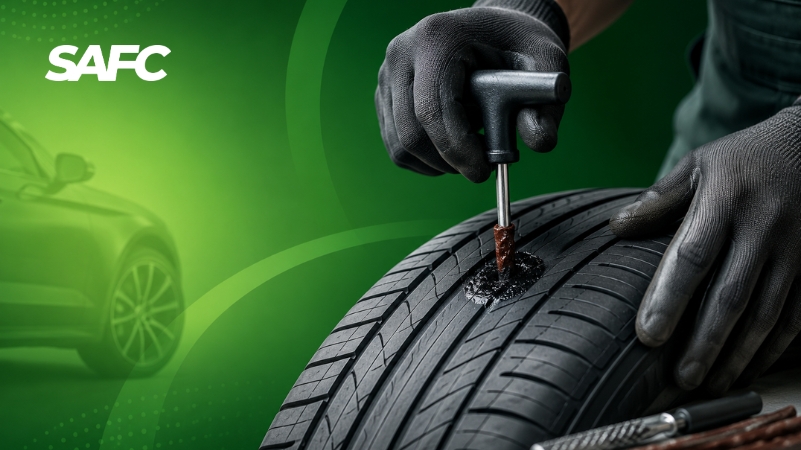
If the puncture is in the tread area (not the sidewall), a tire plug can be a quick fix to get you moving. These kits are widely available at hardware stores and auto shops, and are popular in the Philippines where road nails and debris are common hazards. Make sure to get one if you have the budget for it!
1. Locate the puncture
Spray soapy water over the tire and look for bubbling, or simply look for the nail or screw still embedded in the tread.
2. Remove the object and ream the hole
Use pliers to pull out the nail. Insert the reaming tool from the kit into the hole and push in and out a few times to roughen and clean the opening.
3. Thread the plug and insert it
Thread a rubber plug strip through the insertion tool. Push it firmly into the hole until about 1 cm of plug sticks out.
4. Trim the excess plug and reinflate
Pull out the tool (the plug stays in), trim any excess rubber flush with the tread, then inflate to the correct pressure.
5. Test the repair
Spray soapy water over the plug and check that no air is escaping. Drive slowly at first and recheck within 30 minutes.
ℹ️ Note
A plug repair is a temporary-to-semi-permanent solution. For a fully trusted long-term fix, have a professional do a patch repair from the inside of the tire.
How to Fix Tire Pressure Problems
Low tire pressure is the sneakiest problem because it happens slowly and you might not notice until your fuel economy drops, your handling feels sluggish, or your tires wear out prematurely.
What’s the Right Tire Pressure?
Check the sticker inside your driver’s door frame — it lists the correct PSI (pounds per square inch) for your front and rear tires. Never rely on the number printed on the tire sidewall — that’s the maximum pressure the tire can handle, not the recommended pressure for your car.
For most passenger cars, the recommended range is between 30–35 PSI. Always check pressure when the tires are cold (before driving more than 3 km).
How to Check and Inflate Your Tires
1. Get a tire pressure gauge
A digital gauge is cheapest and most accurate. Available at any hardware or auto parts store for under ₱200–₱400 in the Philippines.
2. Remove the valve cap and press the gauge onto the stem
Press firmly to get a reading. The gauge will show the current pressure in PSI.
3. Inflate or deflate to the correct level
Use an air pump to add air if low. If overfilled, press the small pin inside the valve stem to release air.
4. Replace valve caps on all four tires
Don’t skip this — valve caps keep dirt and moisture out of the valve, preventing slow leaks.
💡 Local Tip for Filipino Drivers
Most vulcanizing shops (vulcanizer) in the Philippines will check and inflate your tires for free or for a very small fee. It’s a good habit to stop at one at least once a month.
Dealing with Uneven Tire Wear
Your tire tread should wear down evenly across the full width of the tire. If it doesn’t, that’s a signal that something is off with your car — and ignoring it means you’ll be buying new tires much sooner than necessary.
Reading Your Tire Wear Patterns
| Wear Pattern | What It Means | Fix |
| Worn in the center | Tire was over-inflated | Reduce pressure to spec |
| Worn on both edges | Tire was under-inflated | Inflate to correct PSI |
| Worn on one edge only | Wheel misalignment | Get a wheel alignment check |
| Cupping or scalloping | Worn shock absorbers or loose parts | Check suspension components |
| Feathering (like fins) | Toe misalignment | Wheel alignment + rotation |
Fix: Tire Rotation
Rotating your tires every 8,000–10,000 km (or roughly every 6 months) distributes wear evenly across all four tires. This is one of the simplest and cheapest ways to double the life of your tires. Any tire shop can do this for you in about 30 minutes.
Solving Vibrations and Wobbling
If your steering wheel shakes — especially at speeds between 80–100 km/h — or the whole car seems to wobble, these are the most likely causes and what to do about them.
1. Check tire pressure first
Uneven pressure in the tires can cause vibrations. Always rule this out before spending money elsewhere.
2. Get your tires balanced
When tires and wheels are balanced, small weights are attached to even out any heavy spots. This is the most common fix for highway-speed vibrations. Cost: usually ₱150–₱300 per tire.
3. Check for bent rims
A bent rim from hitting a deep pothole will cause a constant, rhythmic vibration. This needs professional straightening or rim replacement.
4. Inspect the wheel bearings
A humming or grinding noise that changes with vehicle speed can indicate worn wheel bearings — a more serious issue that needs immediate attention from a mechanic.
Repair or Replace? How to Make the Right Call
Not every tire problem can or should be repaired. Here’s a quick guide to help you decide.
| Situation | Repair or Replace? |
| Nail/screw in the tread area, hole smaller than 6mm | Can Repair |
| Puncture in the sidewall or shoulder | Replace |
| Bulge or bubble in the sidewall | Replace Immediately |
| Tread depth below 1.6mm (2mm in wet climates) | Replace |
| Multiple repairs on the same tire | Consult a Pro |
| Cracking on the sidewall (minor) | Monitor Closely |
| Deep cracking or dry rot throughout | Replace |
| Tire is more than 6 years old | Have It Inspected |
| Hole larger than 6mm in diameter | Replace |
“If in doubt, replace. A new tire costs far less than a hospital visit or a totaled car.”
The Coin Tread Depth Test
No tread depth gauge? Insert a Philippine 1-peso coin into the tire tread groove. If you can see the full edge of the coin above the tread, your tires are dangerously worn and need replacing. In the Philippines where rains are heavy, this test is especially important during the wet season.
Major repairs and replacements can become costly fast. SAFC helps vehicle owners access financing solutions when they need extra support.
Emergency Tire Situations: What to Do Right Now
🚨 Your Tire Blows Out While Driving
- Stay calm and keep a firm grip on the steering wheel. A blowout will pull the car to one side.
- Do NOT slam the brakes. Gently ease off the accelerator instead.
- Steer straight and let the car slow down naturally while pulling toward the road shoulder.
- Once safely stopped, turn on your hazard lights immediately.
- Stay inside the vehicle if on a highway and call for roadside assistance if you’re not confident changing the tire yourself.
🛞 Your Tire is Rapidly Losing Air While Parked
- Do not drive the car — even a short distance on a flat rim can damage the tire beyond repair and destroy the rim.
- Check for the source: nail, damaged valve stem, or rim leak.
- If you have a can of tire sealant foam (e.g., Fix-a-Flat), this can temporarily inflate the tire enough to drive to a shop.
- Call a mobile vulcanizing service — many operate in Philippine cities and barangays.
Tire Maintenance: Prevention is the Best Fix
The best way to handle tire problems is to avoid them in the first place. Here’s a simple maintenance routine that will save you money and keep you safe.
Weekly: Do a visual check of all four tires. Look for nails, bulges, or visible low pressure.
Monthly: Check tire pressure with a gauge. Inspect tread depth and sidewall condition.
Every 8–10k km: Rotate your tires to ensure even wear across all four positions.
Every 10–15k km: Get a wheel alignment check, especially after hitting potholes.
Every 20k km: Have your wheel balance checked and adjusted.
Every 5–6 years: Have tires professionally inspected for aging, even if tread looks fine.
Quick Maintenance Checklist
- Keep a tire pressure gauge in your glove compartment
- Check tire pressure before long road trips
- Avoid driving over potholes at speed whenever possible
- Don’t overload your vehicle beyond the rated capacity
- Park in the shade when possible to reduce UV tire degradation
- Keep a spare tire, jack, and lug wrench in your car at all times
- Learn how to read the tire size and age code on the sidewall
Beginner Mistakes to Avoid
Even well-meaning drivers make these common errors. Avoid them to protect your tires — and your safety.
- Ignoring the TPMS warning light: That tire pressure warning on your dashboard isn’t optional. Driving on low pressure causes tire heat buildup that can lead to blowouts.
- Mixing tire types on the same axle: Putting one new tire and one worn tire on the same axle creates uneven braking. Always replace tires in pairs (at minimum).
- Driving on a flat rim to “get to the shop”: Even 100 meters on a flat tire can destroy the rim. Call for help or change to the spare.
- Using a plug repair and calling it done forever: A plug is a great temporary fix, but get a proper internal patch repair done by a professional when you can.
- Forgetting to check the spare tire: Many drivers discover their spare is flat right when they need it. Check it every 3 months.
- Skipping wheel alignment after an accident or heavy impact: Even a hard pothole hit can knock your alignment off, causing uneven wear you won’t notice until the tires are ruined.
You’ve Got This — Take Care of Your Tires Today
Tires aren’t glamorous, but they’re one of the most important parts of your vehicle. The knowledge you’ve gained from this guide gives you a real edge: you can now spot problems early, handle emergencies confidently, and make smart decisions about when to repair or replace.
Start with the simple things: check your tire pressure this week, do a quick visual inspection, and make sure your spare is inflated. These small habits take under five minutes and can literally save your life.
And remember — when something looks wrong and you’re not sure, it’s always better to ask a professional than to guess. A good vulcanizer or tire shop can usually spot a problem in minutes.
Safe driving out there. 🚗