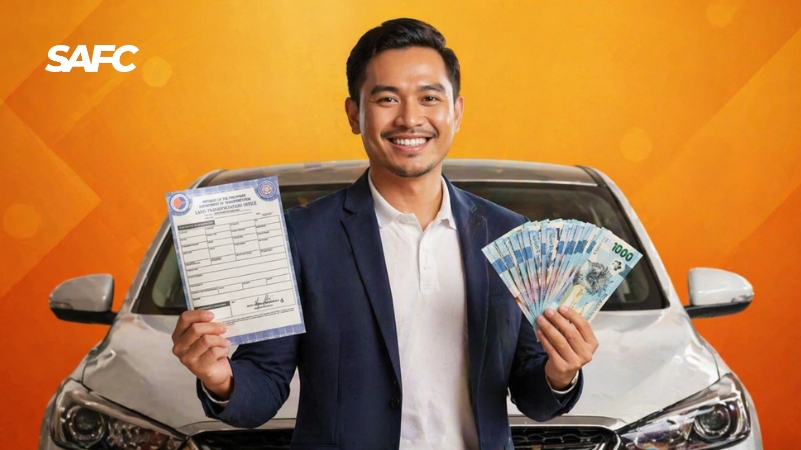
Running a small business in the Philippines means making tough financial decisions — often under pressure and without the luxury of time. When urgent capital needs arise, the traditional bank loan process can feel like a wall of paperwork, waiting periods, and requirements that most SME owners simply cannot meet fast enough.
That is where Sangla OR/CR comes in.
This guide explains exactly how Sangla OR/CR works, how much you can borrow, and whether it is the right move for your business — so you can make a confident, well-informed decision.
How Does Sangla OR/CR Actually Work? (Step-by-Step Process)
Understanding the process is key before committing to any loan. While SAFC has published a full step-by-step breakdown in a dedicated guide, here is a quick overview of how the Sangla OR/CR loan process works — from application to fund release.
| Step | What Happens | Typical Timeline |
| 1 | Submit application online or at a branch | Day 1 |
| 2 | Submit vehicle documents + requirements | Day 1 |
| 3 | Vehicle appraisal — lender evaluates market value | Day 2 |
| 4 | Loan offer presented with full term breakdown | Day 2–3 |
| 5 | Contract signing — borrower reviews and agrees | Day 2–3 |
| 6 | Funds released to borrower | Day 2–3 |
| 7 | Monthly repayment begins | Per agreed schedule |
| 8 | Full repayment → OR/CR returned, loan closed | End of term |
Want the complete breakdown — including full requirements, sample loan computations, and eligibility criteria? Read SAFC’s full guide: How Sangla OR/CR Works: Requirements & Loan Process in the Philippines
What Happens to Your OR/CR While the Loan Is Active?
One of the most common concerns among first-time borrowers is what actually happens to their vehicle documents once a Sangla OR/CR loan is approved. The answer is straightforward — and understanding it helps set clear expectations before signing any agreement.
The lender physically holds the OR and CR for the entire duration of the loan. Once the loan agreement is signed and funds are released, the borrower surrenders the original Official Receipt and Certificate of Registration to the lending institution. These documents are kept securely by the lender and serve as the primary security for the loan. They are not submitted to any government agency on the borrower’s behalf — they simply remain in the lender’s custody until the loan is fully settled.
Regarding lien notation at the Land Transportation Office (LTO), practice varies depending on the lender:
- Some lenders require LTO lien notation — a formal annotation on the vehicle’s registration record indicating that the OR/CR is currently held as collateral. This creates a public record of the encumbrance and legally prevents the vehicle from being transferred or sold without the lender’s consent.
- Other lenders do not require LTO annotation and rely solely on holding the physical documents as security. In this case, no formal record is entered at the LTO, though the borrower remains equally bound by the loan agreement.
Borrowers should clarify this with their lender before signing, as it affects the documentation process and any future transactions involving the vehicle.
During the loan period, the vehicle cannot be sold, transferred, or used as collateral for another loan. The borrower does not have legal authority to transact the vehicle while the OR/CR remains in the lender’s possession — regardless of whether a lien has been formally noted at the LTO.
However, there is no impact on the borrower’s daily use of the vehicle. The car, van, truck, or motorcycle remains fully operational and in the borrower’s possession throughout the entire repayment period. Businesses that depend on their vehicles for deliveries, client visits, or daily operations can continue without interruption.
In summary: the lender holds the paper, the borrower keeps the keys.
How Sangla OR/CR Can Help Your Small Business Grow
For many Filipino small business owners, the gap between opportunity and capital is not a matter of ambition — it is a matter of timing. Sangla OR/CR exists precisely to close that gap, turning a vehicle that is already working for the business into a financial asset that works even harder.
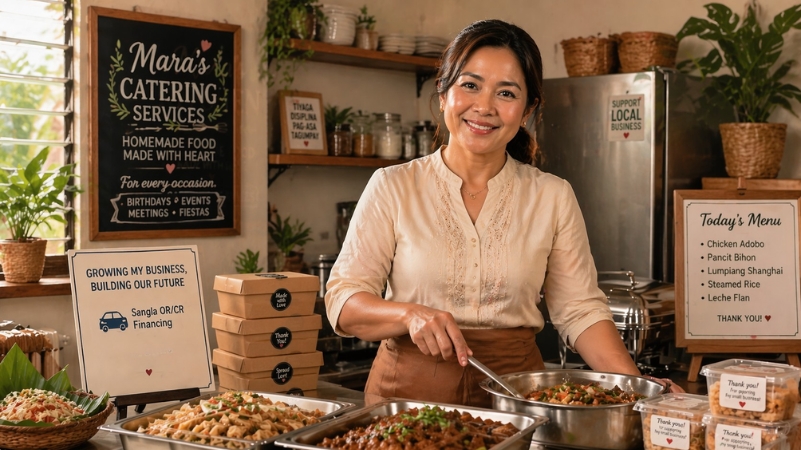
Consider the experience of Mara, a small catering business owner from Bulacan. When a corporate client approached her with a ₱500,000 contract for a three-month event series, the opportunity was exactly what she had been working toward. The problem was immediate: she needed new equipment and two additional staff members before the first event — and she needed them fast. A bank loan was out of the question given the timeline. Her savings were already committed to ongoing operations.
Mara used the OR/CR of her 2021 Toyota Innova to secure a ₱400,000 loan in one day. She fulfilled every event on the contract, repaid the loan within four months, and converted that single opportunity into a ₱1.2 million annual catering account. Her vehicle never left her driveway during the process.
Mara’s story is not unique. Across industries and business sizes, Filipino entrepreneurs are using Sangla OR/CR to respond to opportunities and challenges that cannot wait for traditional financing timelines.
| Business Type | Challenge | How Sangla OR/CR Helped |
| Delivery / Logistics | Needed a second vehicle but cash was tied up in operations | Used existing van OR/CR to fund the down payment on an additional unit |
| Retail / Sari-sari Store | Supplier offered a bulk discount with a 7-day payment deadline | OR/CR loan funded the full inventory purchase within 4 days |
| Food & Catering | Won a large event contract but lacked equipment and staff | Secured a loan against vehicle OR/CR and fulfilled a ₱500,000 contract |
| Construction Services | Critical equipment breakdown brought an active project to a halt | Emergency OR/CR loan funded repairs and restarted the project within 1 week |
| Freelance / Professional Services | Needed to onboard 3 additional staff for a high-value project | OR/CR loan covered the payroll bridge during project ramp-up |
What these scenarios share is a common thread: a business with real revenue potential, a vehicle already in its possession, and a financial need that demands speed over bureaucracy. Sangla OR/CR consistently delivers on that combination.
Is Sangla OR/CR Right for Your Business? (A Quick Self-Assessment)
Before pursuing any financing option, business owners should assess whether it genuinely fits their situation. The following framework helps cut through uncertainty and arrive at a clear, honest answer.
✅ Sangla OR/CR is likely a good fit if:
- The business needs funds within one to two weeks and cannot afford delays.
- The vehicle is fully paid off, registered under the owner’s or business’s name, and has no existing lien.
- There is a clear, realistic repayment plan tied to expected business revenue — not assumptions.
- The business has been turned down by traditional banks or cannot meet their documentation requirements within the required timeframe.
⚠️ Consider alternatives first if:
- A bank SME loan or government program such as SB Corp, Pag-IBIG MSME, or DTI P3 is accessible — these typically carry lower interest rates.
- The vehicle in question is the business’s sole income-generating asset and repayment capacity is uncertain — the risk of default and potential repossession outweighs the benefit.
- The capital requirement exceeds what the vehicle’s appraised value can realistically support — borrowing against an asset’s limit without a strong repayment plan creates unnecessary financial pressure,
Sangla OR/CR is a powerful tool when used with purpose and preparation. It rewards businesses that have a specific funding need, a clear plan to generate returns, and the discipline to repay on schedule. For those businesses, it can be the difference between watching an opportunity pass and seizing it.
Final Thoughts — Is Sangla OR/CR the Right Move for Your Business?
Every financial decision carries weight — especially for a small business where cash flow, assets, and daily operations are closely connected. Sangla OR/CR is not a one-size-fits-all solution, but for the right business at the right moment, it is one of the most practical and accessible forms of capital available in the Philippines today.
After walking through the mechanics, the numbers, the use cases, and the risks, the decision ultimately comes down to three clear situations where Sangla OR/CR makes strong financial sense:
- When speed is non-negotiable. A time-sensitive contract, a bulk purchasing window, a sudden equipment failure — these are moments where a five-to-seven day funding timeline is not a convenience but a competitive necessity. No traditional bank loan moves that fast.
- When the business has a vehicle asset and a verified repayment source. A fully paid, registered vehicle combined with a specific, revenue-backed repayment plan is the foundation of a responsible Sangla OR/CR loan. When both are in place, the risk profile is manageable and the benefit is real.
- When traditional financing is out of reach. For SMEs that do not yet meet the documentary or credit requirements of banks, Sangla OR/CR provides a legitimate, regulated alternative — one that builds borrowing history and opens doors to larger financing in the future.
At the same time, there are two situations where exploring alternatives first is the wiser path. If a government SME program or bank loan with lower interest rates is genuinely within reach, the cost savings over the life of the loan are significant and worth the additional processing time. And if the vehicle being used as collateral is also the business’s primary income-generating asset — the delivery truck that keeps orders moving, the service vehicle that gets to every client — the consequences of default extend far beyond the loan itself. In those cases, a more conservative financing approach protects both the business and its operations.
When used responsibly — with a clear repayment plan and a verified, SEC-registered lender — Sangla OR/CR is one of the most accessible and practical financing tools available to Filipino SME owners. It does not require property collateral, lengthy financial audits, or months of waiting. It requires a vehicle, a plan, and the discipline to follow through.
For business owners who meet those conditions, the question is less about whether Sangla OR/CR is a good idea — and more about finding the right lender to make it work.
SAFC has been helping Filipino borrowers access responsible, transparent vehicle-backed financing since 2003. If your business is ready to explore what a Sangla OR/CR loan can do for your growth, SAFC’s team is ready to walk you through your options — clearly, honestly, and without pressure.